Governments Don't Need Another Risk Model. They Need a Usable One.
We leverage statistical probabilities with the Risk Reserves Tool. Lets review why.
This article was written by Shayne Kavanagh of GovFiSolutions and Matt Posner of Resilient America
Key Takeaways
1. Precision Doesn't Equal Better Decisions. Governments need models that translate complex risks into actionable financial insights, not just increasingly detailed hazard predictions.
2. Probability Makes Uncertainty Actionable. By simulating thousands of possible outcomes, governments can understand the likelihood of fiscal stress, evaluate reserve adequacy, and make better-informed investments.
3. Government Risk Must Be Viewed as a Portfolio. Physical, economic, and financial risks are interconnected. Probabilistic modeling brings them together to reveal how the entire government budget performs under stress.
Over the past decade, our ability to model risk has become extraordinarily sophisticated. We can map flood depths parcel by parcel, estimate wildfire exposure structure by structure, model hurricane winds at high spatial resolution, and increasingly predict how hazards will interact with infrastructure systems. For governments, however, more precision does not automatically produce better decisions.
A mayor, city manager, budget director, or county administrator faces a fundamentally different question from the one most sophisticated risk models are designed to answer. They do not simply need to know which building might flood. They need to know what range of financial outcomes their government could face, how much risk they are carrying, how much they should reserve for it, and which investments would meaningfully change that exposure.
Most existing tools run into a structural limit trying to answer that: they are deterministic. A deterministic model reduces every uncertain input, the cost of a storm, the depth of a recession, the pace of federal reimbursement, to a single best-guess number, then calculates everything downstream from that one scenario. It is easy to explain and easy to defend in a budget hearing, but it is only ever as good as the specific combination of assumptions built into it, and the future rarely arrives holding that exact combination. Run the same deterministic model with a slightly different assumption and it produces a completely different answer, with no way to say which answer (or anything in between) is more likely.
Answering those questions well may require something simultaneously less precise and more accurate: probability. This is the premise behind the emerging discipline of "probability management," pioneered by Stanford professor Sam Savage and the nonprofit ProbabilityManagement.org (PM). Its open-source SIPmath standard is built around a deceptively simple idea: instead of communicating uncertainty as a single forecast, uncertainty can itself be treated as data. Rather than saying an uncertain cost will be $10 million, a Stochastic Information Packet, or SIP, represents thousands of possible realizations of that cost at once. Critically, relationships among uncertain variables can be preserved inside that same structure, so different risks can be combined rather than analyzed only in isolation. The resulting probabilities can be added, subtracted, multiplied, and otherwise incorporated into ordinary analytical models. PM describes the resulting information as "actionable, arithmetical, auditable, and agnostic,” including agnostic to the software platform in which it is ultimately used.
That architecture is particularly well suited to government. Imagine creating a simplified financial representation of an entire city or county: its revenues, expenditures, reserves, debt service, infrastructure, insurance, major assets, and exposure to different hazards. Instead of pretending we know precisely what each of those variables will be in the future, as a deterministic model must, we assign reasonable probability distributions to the variables that are uncertain, preserve the relationships among them, and then run the government forward, not once, but thousands of times. In the RiskReserves Tool, we use at least 10,000 Monte Carlo trials. One simulated future might include a relatively benign combination of events. Another might include an economic slowdown alongside a major storm. Others may combine moderate physical losses, revenue volatility, insurance costs, infrastructure failures, and other shocks in thousands of different permutations. No individual trial is a prediction and that is precisely the point, it's the deterministic model's core weakness turned into the probabilistic model's core strength. Rather than betting everything on one scenario being right, the exercise assumes every plausible scenario might happen, and asks how often, and how badly.
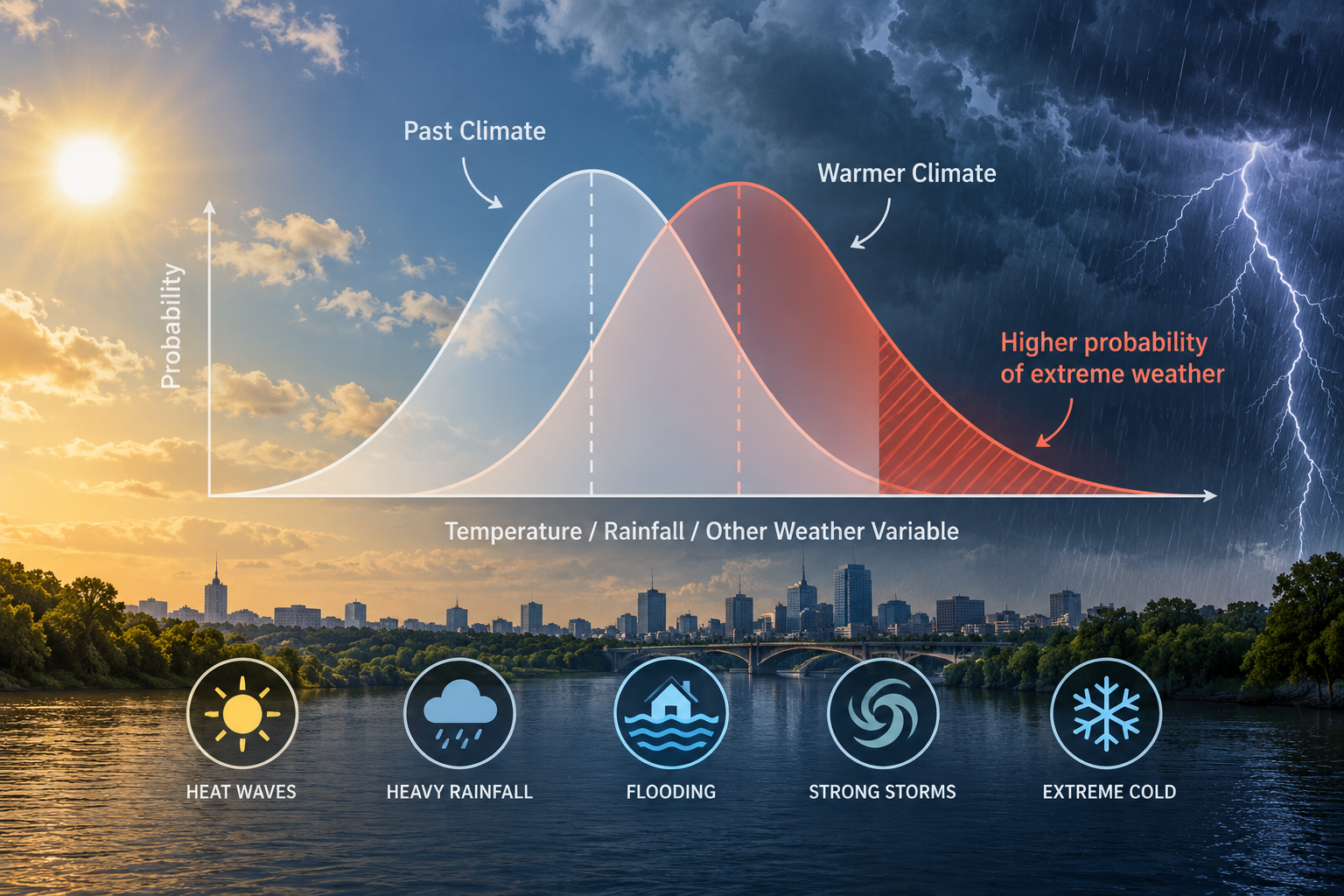
Taken together, the 10,000 trials create a distribution of possible financial outcomes. Government leaders can see the median outcome, but also the tails. They can ask how frequently losses exceed existing reserves, estimate the probability that a particular combination of shocks creates severe fiscal stress, and, because the model isn't locked to one assumption, they can change those assumptions or potential investments and rerun it to see how the whole distribution shifts. The conversation therefore changes from "What will this disaster cost?," a question a deterministic model answers with false confidence, to "How likely are we to experience losses of different magnitudes, and how prepared are we for them?" — a question only a probabilistic one can actually answer.
That distinction is easy to underrate, because there's an understandable temptation in modern risk analytics to equate resolution with usefulness: a model capable of estimating flood damage for an individual structure feels more sophisticated than one estimating a distribution of losses across a jurisdiction. For certain decisions, such as where to elevate a road, how high to build a seawall, which properties to acquire, that structure-level precision is indispensable, and a deterministic engineering estimate is exactly the right tool for it.
But government itself is not a collection of independent parcels; it is a portfolio. A flood affects roads, buildings, utilities, emergency operations, revenues, and expenditures simultaneously. Wildfire can damage assets while reducing economic activity and increasing emergency expenditures. Infrastructure failures can compound natural hazards. Meanwhile, the government's capacity to absorb those losses depends on reserves, liquidity, insurance, borrowing capacity, and competing demands on its budget, all of which are themselves uncertain. The more narrowly, and more deterministically, we model each individual component, the easier it becomes to lose sight of how the whole system behaves under stress.
For government, this suggests something powerful: we do not necessarily need one enormous deterministic model of everything. We need a common language through which many independent sources of uncertainty (a sophisticated flood model, a wildfire model, an infrastructure condition assessment, an economic forecast, an actuarial analysis, a revenue projection) can each remain as sophisticated and specialized as they already are, while still speaking to one another as probability distributions inside a single government-wide financial model.
The next generation of public-sector risk modeling shouldn't be a competition between high-resolution analytics and probability: we need both. Detailed, deterministic models can and should keep getting better at describing individual hazards and assets in isolation. Probability is what provides the connective tissue between them: for a government trying to decide how much risk it can tolerate, how much money it should hold in reserve, or whether spending a dollar today reduces the probability of losing ten dollars tomorrow, the most useful model may not be the one that claims to know exactly what will happen. It may be the one that is clearest about what we do not know, and gives decision-makers a practical way to act on it anyway.